
Supervising Digital Platforms: Where Do We Stand Two Years into the DSA Era?
17 February 2026
Since 17 February 2024, the Digital Services Act (DSA) has introduced new rules for online services, aiming to reduce the distribution of illegal content and increase transparency. While the general rules have applied since early 2024, specific obligations for Very Large Online Platforms (VLOPs) and Very Large Online Search Engines (VLOSEs) – services reaching over 45 million monthly users in the EU – became applicable four months after their designation by the European Commission (starting in August 2023 for the first 19 services). For the first time, the European Commission acts as the exclusive regulator for VLOPs and VLOSEs, this centralization of supervisory powers ensuring harmonized enforcement across the Single Market.
The main purpose of this paper is to provide a brief overview of the 2026 enforcement scoreboard and the case law resulting from the examination of the DSA provision before the Cour of Justice of the European Union.
As of February 2026, the Commission directly supervises 25 designated services:AliExpress, Amazon Store, App Store, Pornhub, Booking.com, Google Search, Google Pay, Google Maps, Google Shopping, Youtube, Shein, LinkedIn, Facebook, Instagram, Bing, XNXX, Pinterest, Snapchat, TikTok, X, Temu, XVideos, Wikipedia, Zalando, and WhatsApp (designated on January 26, 2026).
From Monitoring to Sanction: The Escalation of the Commission’s Powers
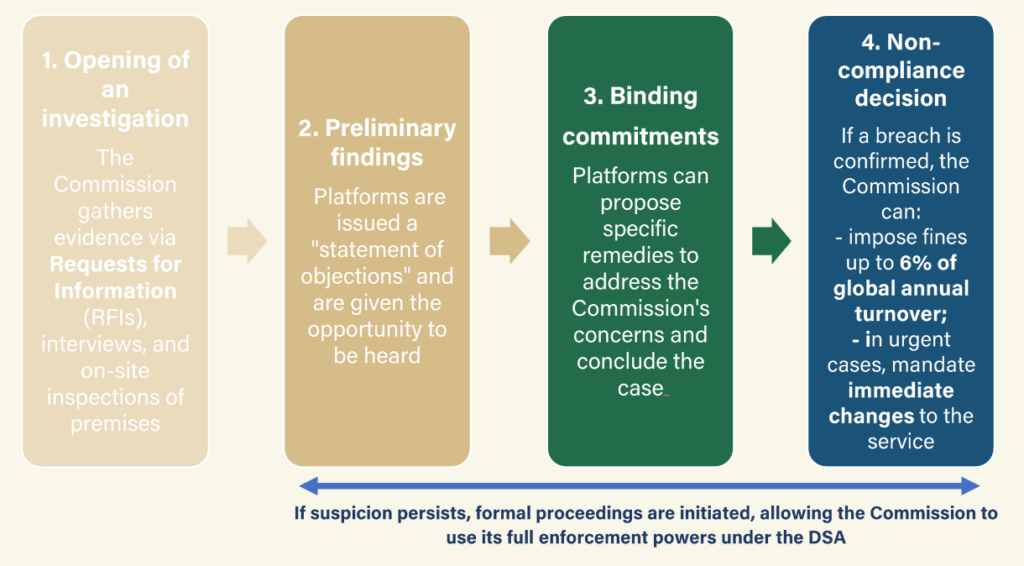
OVERVIEW OF THE 2026 enforcement SCOREBOARD
Here are the key results of the Commission’s enforcement actions as of February 2026:
ONE VLOP HAS BEEN SANCTIONED
On December 5, 2025, the Commission imposed a €120 million fine on X. This sanction was the result of a formal proceeding opened in December 2023 for failing to comply with fundamental DSA obligations. The Commission continues to investigate X’s “Grok” AI and recommender systems.
TWO VLOPS HAVE ENTERED INTO BINDING COMMITMENTS
Before a non-compliance decision is issued, platforms may offer binding commitments to address the Commission’s concerns. If accepted, these commitments become legally enforceable. To date, two VLOPs have entered into binding commitments:
- TikTok (August 2024 & December 2025): The first major set of commitments involved the permanent suspension of the “TikTok Lite” reward functionalities in the EU, in order to address concerns relating to addictive design and mental health risks for minors. A second set of commitments, concerning advertising transparency, was accepted in December 2025.
- AliExpress (June 2025): Following the Commission’s preliminary findings, AliExpress legally committed to a series of remedies to address the risks identified during the investigation. These included strengthening systems to detect illegal products, improving notice-and-action and complaint-handling mechanisms, increasing advertising transparency, and enhancing seller traceability.
SEVEN VLOPs ARE SUBJECT TO FORMAL PROCEEDINGS
Beyond those already sanctioned or that have entered into binding commitments, the Commission has opened seven formal investigations into systemic failures across various sectors.
These include:
- Ongoing proceedings for Facebook and Instagram (Meta): Commission preliminarily found Meta in breach of their transparency obligations;
- Temu (Whaleco): Commission preliminarily found Temu in breach of the Digital Services Act in relation to illegal products on its platform;
- Adult Platforms: Pornhub (Aylo Freesites), XNXX (NKL Associates), and XVideos (WebGroup Czech Republic) are all under formal scrutiny for their age verification and risk mitigation measures
In addition, as regards TikTok, and without prejudice to the platform’s ongoing commitments (see above), the Commission announced in February 2026 its preliminary finding that certain core design features – including infinite scroll, autoplay, push notifications and highly personalized recommendation systems – may infringe the DSA, on the ground that TikTok failed to adequately assess and mitigate the risks of addictive effects, particularly in relation to minors.
FOURTEEN VLOPs ARE SUBJECT TO REQUESTS FOR INFORMATION
All other designated platforms (fourteen in total), including Amazon Store, Google Search, YouTube and Shein, are under active monitoring through RFIs issued by the Commission.
Wikipedia, designated in April 2023, and WhatsApp, which was only designated on 26 January 2026, are the only two designated services not currently subject to this monitoring.
DSA provisions testeD IN court
The legal framework is being tested in court: Zalando and Amazon are currently appealing their designations, while Meta and TikTok successfully challenged the 2023 supervisory fee methodology.
The Zalando designation challenge
- April 25, 2023: The Commission designates Zalando as a VLOP.
- September 3, 2025: The General Court dismisses Zalando’s action and upholds the designation. In essence, the Court’s reasoning is based on the fact that Zalando’s interface displays both its own products and third-party offers simultaneously, making it technically and legally impossible to distinguish users based on the business model.
- November, 13 2025, Zalando lodges an appeal before the CJEU, which is currently pending.
The Amazon designation challenge
- April 25, 2023: The Commission designates Amazon as a VLOP.
- November 19, 2025: The General Court dismisses Zalando’s action and upholds the designation. Here, the case is not primarily about how users are counted, but about the EU law concept of VLOP qualification and the legal rationale for subjecting certain platforms to systemic risk obligations.
- January 29, 2026: Amazon lodged an appeal before the CJEU, which is currently pending
The supervisory fees challenge (Meta & TikTok):
Meta and TikTok successfully challenged the 2023 supervisory fees methodology
- 2023: The Commission adopts implementing decisions setting supervisory fees for VLOPs and VLOSEs under the DSA.
- 10 September 2025: The General Court annuls the Commission’s fee decisions, holding that the methodology for calculating average monthly active recipients constitutes an essential element of the fee system and therefore should have been adopted by delegated act. The Court provisionally maintains the effects of the decisions for up to 12 months.